
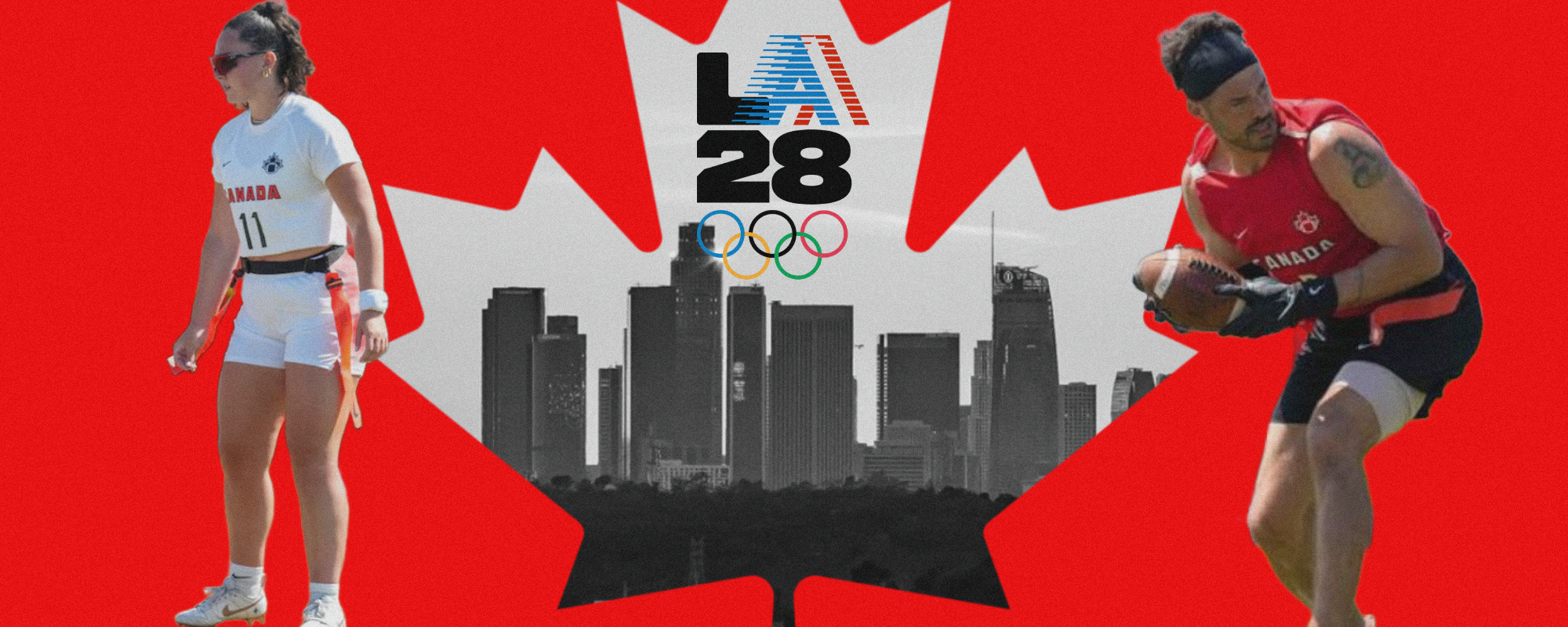
Twenty Canadian flag football players will have an opportunity to compete at the 2028 Los Angeles Olympics. Football Canada CEO Eva Havaris wants their names to be familiar to Canadians long before the Games begin.
But what happens when a child watches those athletes compete and decides they want to try the sport themselves?
That's a different challenge from preparing a national team to win an Olympic medal, and one Football Canada is beginning to address as it prepares for flag football's Olympic debut.
In an exclusive written interview with Past The Play, Havaris revealed that the organization is hiring senior sport-development leadership to work with provincial football organizations on making the sport easier to access.
“We are hiring senior leadership on the sport development side to work in partnership with our Provincial Football Organizations to ensure the football ecosystem in Canada is aligned, easy to navigate, and offering affordable and accessible opportunities for kids to pursue an interest in football,” Havaris said.
It’s an ambition that will be music to the ears of Canadian football fans and parents. And unlike the results of Canada's national teams, its success won't be measured on a scoreboard.
## An opportunity Canadian football hasn't had before
Canada enters the Olympic buildup with both its men's and women's teams qualified for Los Angeles.
The women defeated the United States 27–20 to win the 2026 IFAF World Championship in Düsseldorf, Germany. The men secured bronze with a 34–26 overtime victory over Mexico.
Canada became the first country to qualify both teams through international competition.
Those results have given Football Canada a strong starting point for promoting a sport that will make its Olympic debut in 2028.
The organization is already preparing its national teams through a series of training camps, including opportunities for established flag football players and professional athletes from the CFL and NFL.
But Havaris sees the upcoming Games as an opportunity to introduce Canadians to more than the national teams.
“We want everyone to know the names of our 20 athletes who will ultimately represent Canadian football on the biggest global sporting stage by the time our teams walk into the stadium for the opening ceremonies,” she said.
It's an ambitious promotional goal. Recognition, however, is only the beginning of participation.
A young athlete inspired by the Olympics still needs a program to join, coaches to learn from and a realistic way to remain involved.
Football Canada's challenge is to ensure those opportunities exist when the interest arrives.
## What does accessibility actually require?
Football Canada is responsible for the national development and promotion of tackle, flag and touch football, working alongside provincial organizations and other partners.
The structure means the national organization cannot build participation entirely on its own.
Community programs, provincial associations, schools and post-secondary institutions all have roles in determining where Canadians can play and how far they can progress.
Havaris's proposed leadership hire is intended to strengthen coordination across that system. Her reference to affordability is also significant. Registration fees are only one potential cost of organized youth sport. Equipment, transportation, travel and the availability of local programs can all influence whether families can participate.
That makes the next stage of its plans important.
An increase in public interest after the Olympics would be encouraging. More children being able to participate consistently would be a stronger measure of the sport's long-term development.
## A CEO who has been through the Olympic cycle before
Havaris is familiar with the demands of national sport administration.
Football Canada appointed her CEO effective June 8, 2026, following a career that included leading Taekwondo Canada and Equestrian Canada through Olympic and Paralympic cycles.
She also held a senior leadership position at Tennis Canada, where her responsibilities included participation growth, infrastructure strategy, provincial and territorial coordination and development pathways.
Football Canada's announcement of her appointment identified the need to strengthen national alignment, develop sustainable funding and connect grassroots participation with high-performance sport.
The new sport-development position fits within that mandate. It also suggests the organization correctly recognizes that Olympic exposure alone won't resolve the challenges involved in growing a national sport.
The difficult work will involve coordination, investment and providing opportunities in communities with different resources and existing football structures.
Havaris has experience working within those systems.
The coming years will show how that experience translates into Football Canada's own development strategy.
## Keeping young athletes involved
There is already one example of how the organization hopes to improve the pathway between grassroots participation and elite competition.
In June, U SPORTS announced that women's flag football would become a pilot sport beginning in 2027–28.
The sport already has an established university structure in Quebec, where eight teams compete through the RSEQ, and Football Canada's 2026 collegiate championship featured 11 teams from across Canada.
The U SPORTS decision creates a framework for developing a more formal national university competition.
For young athletes, that could eventually mean more opportunities to continue playing after high school.
Havaris wants to go further.
By 2032, she hopes women's flag football will be an official championship sport across U SPORTS and the Canadian Collegiate Athletic Association, with conferences throughout the country adopting the game.
The connection between those ambitions and the proposed development leadership is clear.
Growing participation is one challenge. Keeping athletes involved as they move through school, university and potentially into national-team programs is another.
A successful system needs to address both.
## The real test comes after Los Angeles
Football Canada has two years to prepare its national teams for the Olympic stage.
The organization will select 10 men and 10 women to represent Canada in Los Angeles, with the final rosters expected to be announced in 2028. The Games will offer a rare opportunity to put Canadian flag football in front of a much larger audience.
But Havaris is already looking beyond that moment.
Asked what would constitute long-term success by 2032, she said she wants football established within Canada's high-performance sport system. She also hopes the sport will be revived as a popular choice for young Canadians, with more children seeing a realistic opportunity to represent their country internationally.
Those goals are harder to measure than medals, but they may ultimately reveal more about the legacy of Canada's Olympic participation. If the sport grows, the questions will be where that growth occurred, who benefited and whether new opportunities became available to families who previously struggled to access them.
If the organization can demonstrate improvements in those areas, its Olympic investment could produce benefits long after the Games.
For now, Havaris has outlined the direction and identified a leadership hire intended to help deliver it. The next step is establishing the measurable commitments behind that ambition.
By 2028, Football Canada hopes Canadians will recognize the 20 athletes wearing the maple leaf in Los Angeles.
By 2032, its success may be better judged by how many children have found somewhere to play because of them.
LONGFORM
Football Canada CEO Wants Olympic Success to Bring More Kids Into the Sport. Can the Organization Deliver? | Exclusive
Eva Havaris tells Past The Play that Football Canada is hiring senior sport-development leadership to improve accessibility and affordability. With LA28 approaching, the organization has an opportunity to turn Olympic exposure into lasting participation.
By Tytan Durgan
November 19, 2026 at 12:36 p.m. · 6 min read
November 19, 2026 at 12:36 p.m. · 6 min read
MORE TO EXPLORE · ALL Other
Reporting · NFL
Football Canada CEO Stresses Team Chemistry & Flag Football Skills as NFL and CFL Players Eye Olympic Spots | Exclusive
Canada's men's flag football players earned their country an Olympic berth. Now they'll compete with professional football stars for the chance to use it
Analysis · NHL
Cutter Gauthier Has Nine Goals in Four Games. Somehow, That's Only Half of Anaheim's Story.
Gauthier's franchise-record scoring streak and Anaheim's remarkable power play have turned the Ducks into one of hockey's most entertaining teams.
Analysis · NBA
Nikola Jokić Has 90 Triple-Doubles That Would Rank Seventh in NBA History. He Needed Just Three Quarters for All of Them.
Ninety of Nikola Jokić's career triple-doubles were completed before the fourth quarter. Even that total alone would tie for seventh in NBA history.