
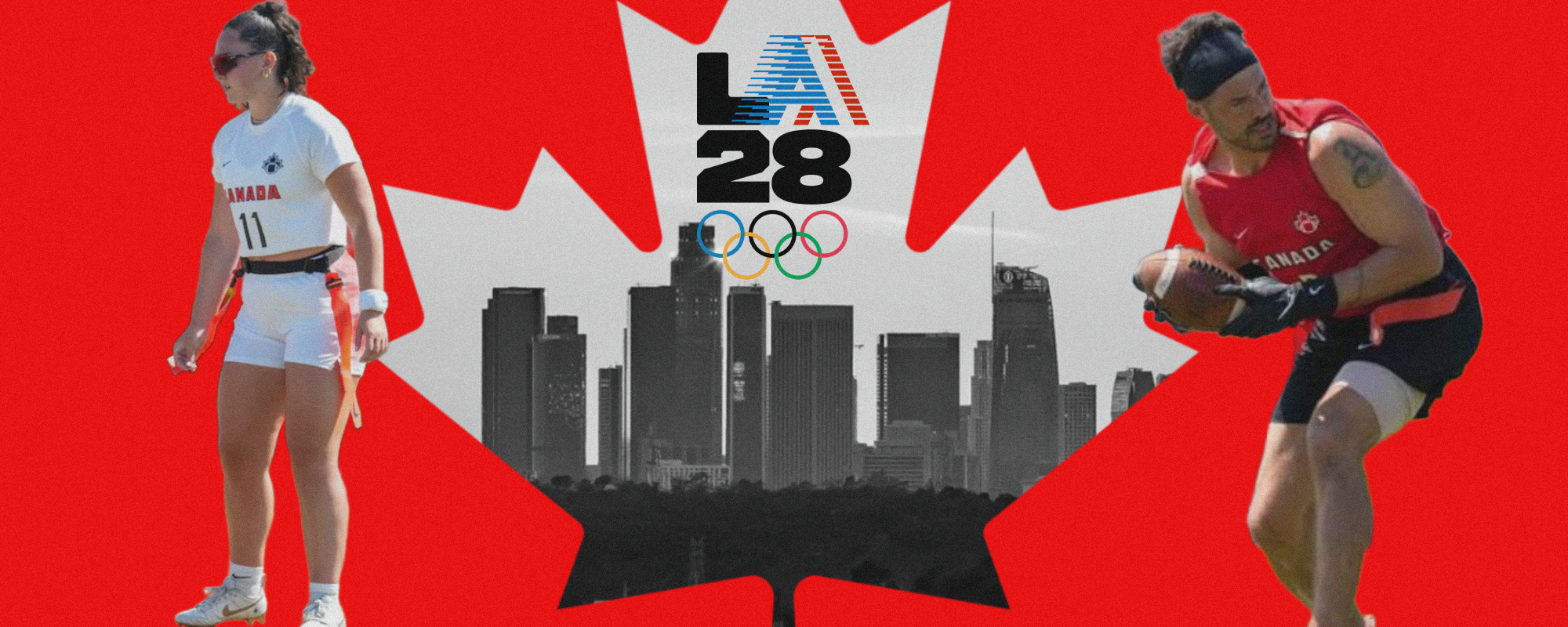
The 12 players who took the Canadian men's team to the podium at the 2026 Flag Football World Championships earned their country the designation of being the first to qualify both its men's and women's programs for the Olympics in flag football's debut on the biggest stage, outside of the host nation. This came after the the women's program qualified for the Olympics the day before by advancing to the finals, which they would also win to bring home gold on the same day as the men's bronze.
What those players didn't earn was a guarantee that they'd be the ones playing in Los Angeles.
Three months after Canada's men defeated Mexico in overtime to secure Olympic qualification, Football Canada's flag program is preparing to look at 18 CFL players, including Nathan Rourke, Tre Ford and Nic Demski. Another 20 Canadian NFL athletes are expected to receive invitations to a separate camp next spring.
The country's existing flag football players aren't being replaced. They're being asked to prove they belong on the best possible team, alongside athletes whose professional careers have largely been spent playing a different version of football.
In an exclusive written interview with Past The Play, Football Canada CEO Eva Havaris emphasized that the Olympic selection process will involve more than evaluating conventional football ability.
“Flag football is its own sport with specific positions that require specific skillsets to be successful,” Havaris said. “Additionally, team chemistry and time together as a team are differentiators in flag football.”
For the players who secured Canada's Olympic berth, those qualities could prove valuable when the different talent pools finally come together.
## Twelve players, ten Olympic places
Canada's men entered the August World Championships in Düsseldorf, Germany, ranked 10th internationally.
They opened the tournament by defeating second-ranked Austria 26–6, with quarterback Michael O'Connor throwing four touchdown passes. The team eventually reached the bronze-medal game, where it defeated Mexico 34–26 in overtime.
The result secured one of the available Olympic qualification places and ensured Canada would be represented in both flag football tournaments at LA28.
Canada's 12-man World Championship roster included O'Connor, Jackson Tachinski, Daniel Petermann, Antony Auclair and Marc-Antoine Dequoy, among others.
Even if Football Canada brought back that entire team, two players would have to be left off the Olympic roster. The Games will feature just 10 athletes per country in each tournament.
Instead, the organization is widening its search.
Its November 18 announcement identifies four groups from which the men's Olympic roster could emerge: the established national team, CFL players, NFL players and other flag football athletes identified through the national program.
The current players will continue training through the winter. The CFL camp begins November 29 in Chula Vista, California, followed by a separate NFL evaluation camp in spring 2027. Other athletes will have opportunities to enter the process through open camps.
The groups are expected to feed into a spring selection camp involving 24 of Canada's top men's prospects.
For head coach Paul LaPolice, the task is no longer simply to develop the group that qualified. It's to determine whether a different combination of players can take Canada further.
## A professional résumé isn't a flag football résumé
The CFL's involvement is significant in its own right.
The league and its players' association reached an agreement allowing active players to participate in Football Canada's national-team activities, including provisions for insurance and health benefits.
The November camp will introduce those athletes to the rules, techniques and systems of international flag football while giving Canadian coaches an opportunity to evaluate them.
The invited group includes quarterbacks Rourke, Ford and Taylor Elgersma; receivers Demski, Justin McInnis, Tyson Philpot and defensive backs Tyrell Ford and Tevaughn Campbell.
Jalen Philpot was also named to the 20-player invite list released by the CFL on November 13, but was not included on Football Canada's 18-player CFL talent list released on November 18.
Their football credentials aren't in question. How those skills translate to the Olympic game remains to be determined.
Havaris acknowledged that professional experience can provide valuable preparation.
“As with all sports, skill in the game, repetition, and performance under pressure translate well to being successful at the highest levels of any sport,” she said. “It is not different in flag football.”
But she also stressed the importance of the specific positional demands of flag football and the chemistry developed through playing together.
That distinction complicates any assumption that the best tackle football players will automatically become Canada's best flag football players.
A receiver's ability to create separation, a quarterback's decision-making and a defender's coverage instincts can carry over. The timing, positioning and tactical responsibilities of international flag football still have to be learned.
Canada's existing team also demonstrates why the divide between professional and flag football experience isn't absolute.
Auclair previously played tight end in the NFL, while Dequoy built his career as a CFL defensive back. Both were members of the World Championship roster that secured Olympic qualification.
The selection process isn't necessarily a contest between professional players and amateurs. It's a competition between athletes with different combinations of football experience.
Havaris did not suggest that established flag football players would receive preferential treatment. Nor did she indicate that any professional player had been promised a roster spot.
The emphasis, instead, is on identifying the athletes best equipped to succeed together.
## Canada's women face a different selection problem
The men's program isn't the only one preparing for difficult decisions.
Canada's women enter the Olympic buildup as world champions after defeating the United States 27–20 in Düsseldorf.
Quarterback Sara Parker was named tournament MVP after throwing 23 touchdown passes across the competition. Frédérique Morneau scored three touchdowns in the final, while Caroline Moquin-Joubert added another.
The team's first Olympic preparation camp begins November 21 in Chula Vista, with 24 athletes invited.
Football Canada plans to reduce that group to 18 for another camp early next year, then select 12 for February's Grand Slam of Flag tournament in Los Angeles.
The eventual Olympic roster will be smaller still.
“The road to being named to Canada's Olympic team on both the men's and women's side will be highly competitive and will include multiple touchpoints in order to select the absolute 10 best athletes to represent Canada in LA at the 2028 Olympic Games,” Havaris said.
The women must decide how to improve a team that has already beaten the world's best. The men must evaluate whether the arrival of professional players can strengthen a program that has already proven itself internationally.
Havaris said Football Canada understands both the strengths it wants to preserve and the weaknesses it needs to address.
“We are also clear about the gaps that we need to close to ensure that both teams are on the podium in LA2028.”
## The next competition may be harder to win
Football Canada hasn't announced which Canadian NFL players will be invited to its spring camp.
Havaris told Past The Play those names will be released closer to the event, leaving another major group of potential Olympic candidates unidentified.
For now, Canada's established national-team players have an advantage that cannot be measured by professional statistics: they've already competed together, learned the international game and succeeded against the countries they'll be trying to beat in Los Angeles.
The newcomers bring a different set of advantages, including years of professional training and experience competing under pressure. The coaching staff will have to determine how those qualities fit together.
Canada's men needed 12 players to earn their Olympic berth. They'll have room for only 10 when the Games begin.
LONGFORM
Football Canada CEO Stresses Team Chemistry & Flag Football Skills as NFL and CFL Players Eye Olympic Spots | Exclusive
Canada's men's flag football players earned their country an Olympic berth. Now they'll compete with professional football stars for the chance to use it
By Tytan Durgan
November 19, 2026 at 12:14 p.m. · 6 min read
November 19, 2026 at 12:14 p.m. · 6 min read
MORE TO EXPLORE · ALL NFL
Reporting · Other
Canada Won Women's Flag Football Gold With 11 Players From Quebec. What Happens When the Rest of the Country Catches Up?
Quebec has provided almost the entire roster of Canada's world championship team. As women's flag football expands through Canadian universities, Football Canada CEO Eva Havaris sees an opportunity to develop talent from coast to coast.
Analysis · NHL
Cutter Gauthier Has Nine Goals in Four Games. Somehow, That's Only Half of Anaheim's Story.
Gauthier's franchise-record scoring streak and Anaheim's remarkable power play have turned the Ducks into one of hockey's most entertaining teams.
Analysis · NBA
Nikola Jokić Has 90 Triple-Doubles That Would Rank Seventh in NBA History. He Needed Just Three Quarters for All of Them.
Ninety of Nikola Jokić's career triple-doubles were completed before the fourth quarter. Even that total alone would tie for seventh in NBA history.