The Champion’s Advantage Is Real. The Reason Is Harder to Prove.
UFC challengers are supposed to win the same round the same way a champion does. When their performances look similar, the scorecards suggest they don't.
By Tytan Durgan October 4, 2026 at 8:00 a.m. · 9 min read · Original Research
ORIGINAL RESEARCHPast The Play tests sports assumptions with original data and transparent methodology.
Every fighter challenging for a UFC title has heard some version of the same advice: if you want the belt, don't leave any doubt.
It's why “you have to beat the champ” has survived for so long. Not edge him. Not make the round difficult to score. Beat him clearly enough that nobody can argue about it.
That's useful advice for a fighter. It isn't how judging is supposed to work.
A close round is still supposed to be scored for whichever fighter just barely won it. The championship belt isn't one of the judging criteria. A straight landed by the champion shouldn't count more than the same straight landed by the challenger. Neither should a takedown, a leg kick or 30 seconds against the fence.
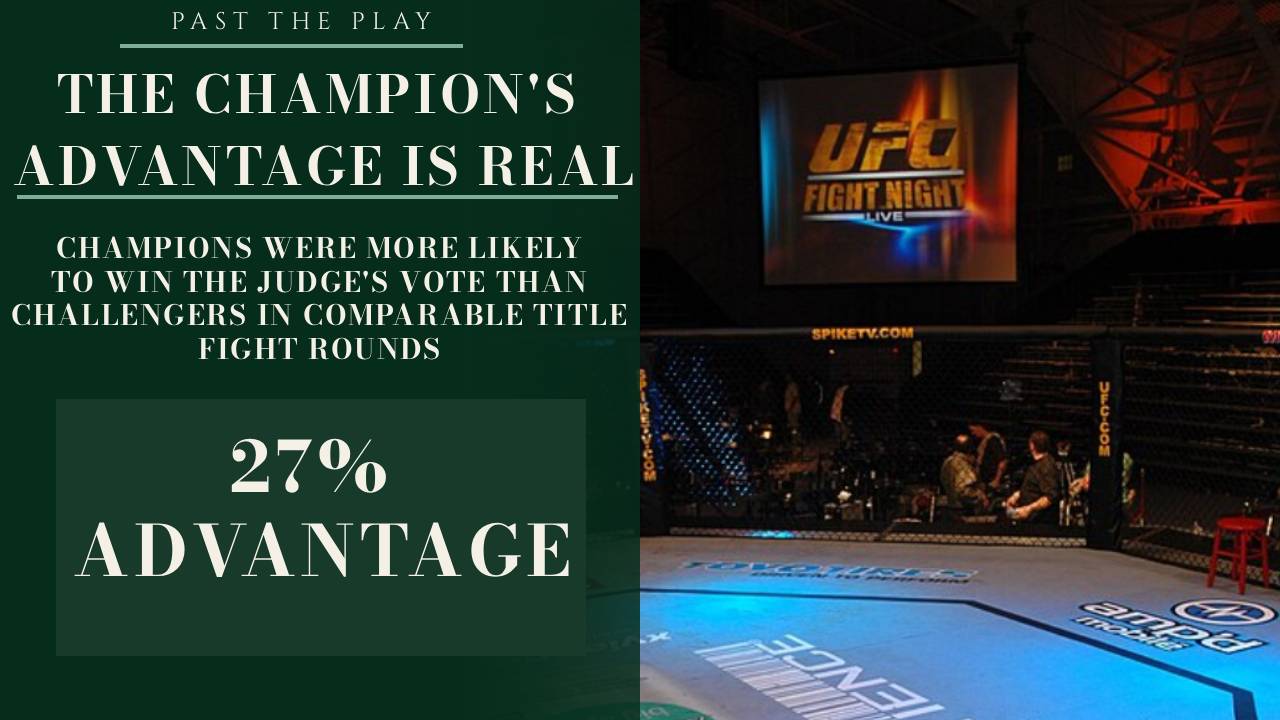
But when I compared UFC title-fight rounds where champions and challengers produced similar measurable performances, the champion was still more likely to get the judges' vote. The difference was roughly 12 percentage points.
That's big enough to take the idea of a champion's advantage seriously. Explaining why it exists is much harder.
How do you compare two MMA rounds?
The obvious problem with studying judging is that fights aren't played on a spreadsheet.
Two fighters can land the same number of significant strikes without those strikes having the same impact. One can land straights and leg kicks while the other badly hurts an opponent with an overhand. A takedown that leads nowhere isn't the same as one that puts a fighter in danger. Control time can mean dominant offence or two fighters fighting for position against the fence.
So simply asking whether champions win more rounds would tell us very little. Champions are usually champions for a reason. If they perform better than their challengers, judges should reward them more often.
The better question is what happens when the measurable performance looks similar.
Merab Dvalishvili gave me an almost perfect example.
In the fifth round of his title challenge against Sean O'Malley, Dvalishvili landed one fewer significant strike than O'Malley but 14 more total strikes. He recorded two more takedowns and 62 more seconds of control, while neither fighter scored a knockdown. None of the three judges gave him the round.
Four months later, Dvalishvili entered the fifth round against Umar Nurmagomedov as the champion. This time, he landed four fewer significant strikes than his opponent but three more total strikes. Again, his takedown advantage was two. His control advantage was 53 seconds instead of 62. Again, there were no knockdowns.
All three judges gave him the round.
Put the performances beside each other and the similarity is hard to miss.
The rounds weren't identical. Public statistics can't completely capture differences in damage, strike quality or effectiveness, so there may be perfectly legitimate reasons Dvalishvili won one set of scorecards and lost the other.
That's why one comparison wouldn't prove much.
So I made 247 of them.
I matched rounds where champions and challengers produced comparable statistical profiles, even when those rounds came from different fights, and compared how often judges awarded those performances to each side.
Across those matched performances, champions were roughly 12 percentage points more likely to receive the judge's vote than challengers producing similar statistical output.
The Merab comparison is one example of the process. The broader result is what makes it interesting.
What the numbers don't see
There is still an important limitation to what those comparisons can tell us.
Public UFC statistics count significant strikes, but not every difference in damage between them. They count takedowns without fully describing what happened because of those takedowns. Control time tells us who controlled position, but not necessarily who created the more meaningful offence while they were there.
Dvalishvili's fifth round against O'Malley helps make the point. His statistical profile looks favourable in several areas, but O'Malley finished the round with some of his better offence. The quality of those moments may have mattered more than the totals suggest.
Judges can see things the box score can't.
That means the 12-point difference isn't proof that judges consciously favour champions. But it also leaves a much larger question: can those unmeasured differences consistently explain why statistically similar performances are rewarded differently depending on who has the belt?
The advantage survives when the rounds get close
There is another way to approach the problem without matching rounds from different fights: look at what happens when a championship round itself is difficult to separate.
That produces a smaller effect than the cross-fight matching, but it points in the same direction. In close title-fight rounds, champion status was associated with an advantage of roughly eight percentage points in the judge's vote.
Dominick Reyes' second round against Jon Jones is a useful example.
Reyes landed 33 significant strikes to Jones' 22. There were no takedowns or knockdowns recorded, and Reyes had also outlanded Jones in significant strikes in the first round and would do it again in the third. Yet two of the three judges gave Round 2 to Jones.
The 33-22 difference doesn't automatically mean Reyes won. Jones was more accurate, and the numbers can't tell us which fighter landed the cleaner or more damaging offence. But there wasn't an obvious knockdown, takedown or other statistical event separating the champion from the challenger. The round required a judgement call, and two of three went to Jones.
Go back more than a decade and the same question becomes even harder to ignore.
In Round 2 of Lyoto Machida's first title fight against Mauricio “Shogun” Rua, Rua landed 21 significant strikes to Machida's seven. He also accumulated 57 seconds of control while Machida had none. Neither fighter scored a takedown or knockdown.
All three judges gave the round to Machida.
Those two rounds don't establish a pattern by themselves. The close-round analysis does.
Across difficult-to-separate rounds in the dataset, champions received the judge's vote about eight percentage points more often than challengers. That is separate from the matched-round result: one analysis compares similar statistical performances across different fights, while the other looks specifically at close rounds within title fights.
Different tests. Same direction.
Takedowns and control don't solve it
One possibility was that champions were getting rewarded differently for grappling.
Control time is one of the easiest statistics to misunderstand because control by itself isn't supposed to outweigh more effective offence. But the visual of a champion holding a challenger against the fence or keeping him underneath can still make a round feel more one-sided than the striking numbers suggest.
If judges were rewarding champion control more heavily, that could explain part of the advantage.
I looked for it.
There are signs that takedowns and control may matter differently depending on who owns the belt, but the interactions weren't strong enough to explain the overall result.
That brings us back to the Merab comparison. As challenger, he had a two-takedown advantage and 62 more seconds of control than O'Malley. As champion, he had the same two-takedown advantage and 53 more seconds of control than Nurmagomedov.
The grappling profile didn't suddenly transform when the belt changed sides. The judging did.
There isn't one obvious statistic you can point to and say, “That's it. That's where the extra champion rounds are coming from.”
It could be damage that isn't captured cleanly in the public data. It could be the way judges interpret positional control. It could be reputation or expectation. It could be some combination of all four.
Finding the advantage was easier than finding its cause.
Reputation is almost impossible to remove from the cage
Judges know who the champion is. They know the fighter walking out second, wearing the belt and being introduced as the best in the world didn't get there accidentally.
That doesn't require a judge to think, consciously, “The challenger has to do more.” Human beings use context constantly when interpreting uncertain information.
If a dominant champion lands a clean right hand, it may register as confirmation of something the observer already expects. If an underdog challenger lands the same shot, the observer may need a little more evidence before deciding the round has shifted.
That doesn't mean judges are dishonest or even that they're doing it intentionally. But when two performances are difficult to separate, reputation can become part of the context through which everything else is interpreted.
That's exactly where championship fights create a problem. The belt is impossible not to see, but it is supposed to be irrelevant to the score.
The advantage is clearer than the explanation
This analysis can't tell us that UFC judges deliberately favour champions. Public fight statistics aren't precise enough to make that claim, and the examples above can't prove what any individual judge saw or valued.
What the analysis can tell us is that two different approaches found the same basic pattern.
Across 247 matched pairs, champions were rewarded about 12 percentage points more often than challengers producing similar measurable performances. Restrict the analysis to close rounds within title fights and a smaller advantage of roughly eight points remains.
Maybe champions consistently produce forms of effective offence our public statistics don't capture. Maybe judges value certain types of control differently. Maybe reputation changes how close exchanges are interpreted. Maybe several small effects combine into one larger one.
The data don't give us a clean answer.
That's the point.
The champion's advantage is easier to find than it is to explain. And until we can explain it, “you have to beat the champ” starts to sound less like advice and more like a description of what challengers are already dealing with.
The champion should not have to lose the belt.
The challenger should only have to win the round.
HOW WE DID THIS
Methodology
Past The Play analyzed round-by-round judging decisions from UFC title fights alongside publicly available performance statistics, including striking, takedown and control measures. The dataset included 111 title fights, 555 completed scored rounds and 1,665 individual judge-round decisions.
The analysis approached the question in two primary ways. First, close rounds within title fights were isolated to test whether champion status was associated with the likelihood of receiving a judge's vote when the competitors were difficult to separate. That analysis produced an advantage of roughly eight percentage points for champions.
Limitations
Second, rounds from different fights were matched according to the fighters' statistical performance relative to their opponents. This allowed a challenger performance in one fight to be compared with a champion performance elsewhere that produced a similar measurable profile. Across 247 matched pairs, champions received the judge's vote at a rate roughly 12.28 percentage points higher than challengers. The estimated 95 percent confidence interval was approximately 7.36 to 17.20 percentage points.
Matched performance does not mean two rounds were identical. Public MMA statistics cannot perfectly measure damage, strike quality, defensive effectiveness, submission danger or every element judges observe cageside. The analysis therefore identifies a difference in how statistically similar performances were rewarded, not proof of conscious bias by individual judges.
Tytan Durgan
Founder and Editor-in-Chief
Founder and Editor-in-Chief of Past the Play.
If you've read our about page, you know why I started Past The Play, but if not, I'll give you a quick explanation. Heading into the 2026-27 NHL season I had started contributing to The Hockey News occasionally, and had been doing a lot of work I felt was high-quality. Unfortunately, I didn't have a home for all of that work as I didn't have enough relationships within the industry to pitch pieces to a bunch of different publications. Instead of posting my work on a Medium or Substack account, I wanted to still have a publication behind my independent work to help it grow and maintain credibility.
I was born and rasied in Brandon, Manitoba, where I fell in love with the game of hockey from a young age, even first skating at only 18 months of age. I've been fortunate enough to have been coached by former professional hockey players at multiple stages in my career and to have competed with and against plenty of talented players who went on to have professional careers. Growing up in a city with such a prevalent hockey culture has given me a different appreciation and understanding for the game that I will always be grateful for.
I've also always been somebody who has loved all sports, ranging from any of the Big 4 professional North American team sports leagues to MMA and even the occasional golf event. As with the sport of hockey, I have always been somebody who's not only been interested in watching and competing but in truly understanding how the sports work and what makes successful teams/athletes succedd, as well as what makes them fail.
I enjoy testing notions we've commonly accepted as fact in sports and seeing if there is any objective proof they exist, as evidenced by 2 of the first 3 pieces on this website being testing refereeing in both the NHL and UFC to see if a certain bias truly exists that had been accepted by the majority of fans and athletes as fact.