Tim Peel Said Make-Up Calls Weren’t Real. More Than 44,000 Penalties Say Otherwise.
The team that received the previous power play took the next penalty more often than expected. The deeper you look, the harder it becomes to dismiss hockey’s oldest officiating suspicion.
By Tytan Durgan October 4, 2026 at 8:00 a.m. · 8 min read · Original Research
Past the Play analysis of 44,143 qualifying NHL penalty sequences.
ORIGINAL RESEARCHPast The Play tests sports assumptions with original data and transparent methodology.
You know the call before it happens. Your team has taken three penalties. The other team hasn't taken one. Then, early in the third period, one of their defencemen gives your winger a little tug along the boards.
Arm up. There it is.
Maybe the hook was real. It usually is. That's part of what makes the make-up call so difficult to prove. Nobody needs to invent a penalty. There are enough borderline hooks, holds, trips and interference plays in an NHL game that eventually a referee gets an opportunity to call one.
Hockey fans have understood this forever. Three power plays to one? Start looking for the next one. Four to one? You might as well start sending the penalty kill unit over the boards.
The NHL rulebook obviously doesn't work that way. A hook is supposed to be a hook whether your team has had zero power plays or five.
The numbers say it doesn't quite work that way either.
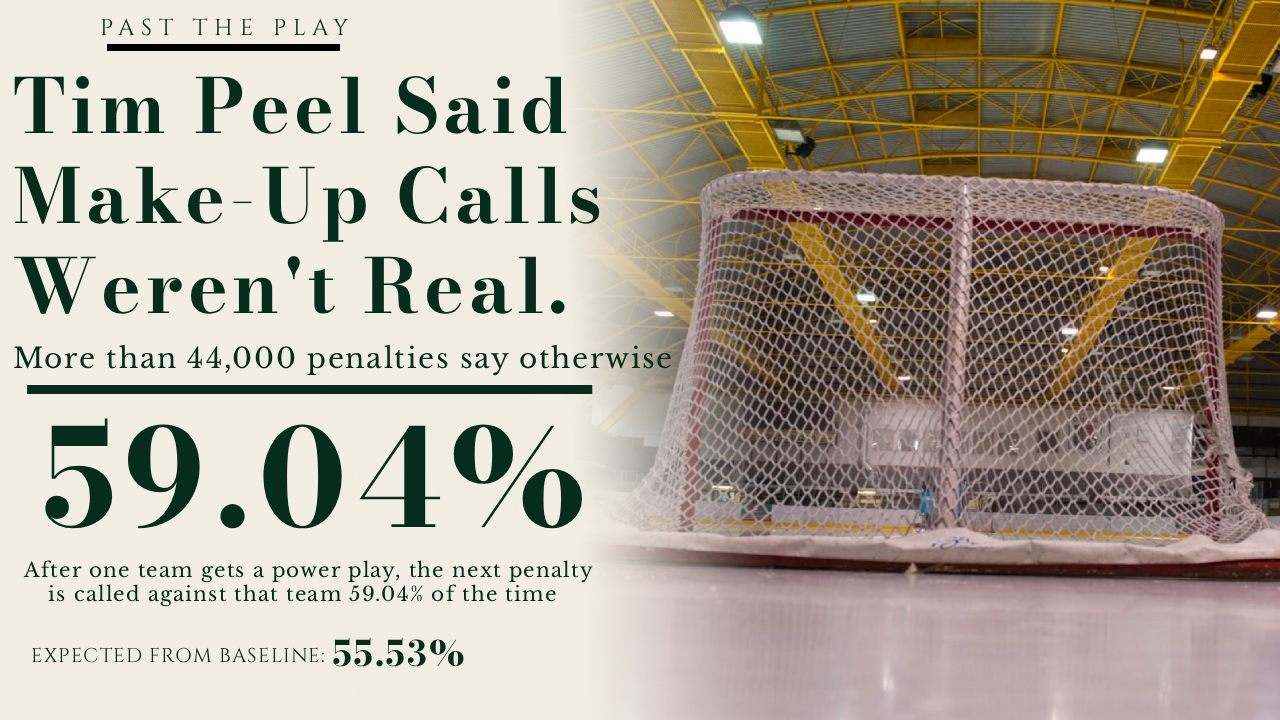
I went through 44,143 instances where one team received a power play and another penalty followed later in the game. The team that got the first power play took the next penalty 59.04 percent of the time.
That number shouldn't be 50 percent. Some teams take more penalties than others. Some draw more. Accounting for those differences pushes the expected reversal rate to 55.53 percent.
It still doesn't get us to 59.04.
That 3.51-percentage-point gap works out to roughly 1,550 more penalties switching sides than expected.
Call them make-up calls. Call it game management. Call it referees becoming a little more interested in the next borderline hook. Whatever name you give it, the previous penalty contains information about what happens next.
And apparently it has for decades.
Hockey has seen this before
The idea of the make-up call is older than most of the players currently complaining about them.
Jason Abrevaya and Robert McCulloch studied NHL penalties from 1995-96 through 2001-02 and found what they called “reverse calls.” Once one team was penalized, the next penalty became more likely to go against its opponent.
David Beaudoin, Oliver Schulte and Tim Swartz found the same basic pattern in games from 2009-10 through 2013-14. Even after accounting for score, time, home ice and team strength, penalty differential was the most influential variable in predicting who would be penalized next.
Those studies covered two very different NHLs. The first included the dead-puck era and, for much of the sample, one-referee games. The second came after the 2005 lockout, with a different rulebook emphasis, more scoring and two referees on the ice.
Now we have another version of the NHL.
Same problem.
Then there is Tim Peel.
During a 2021 game between Nashville and Detroit, Peel was caught on a live microphone saying he “wanted to get” a penalty against Nashville early in the period. The NHL announced the next day that he would no longer work games.
A year later, Peel was asked directly whether make-up calls exist.
“Make up calls are not a thing,” he wrote.
His explanation made that denial considerably more interesting.
Peel said that when officials have called several penalties against one team, their “antennas are up” to make sure they don't miss one against the other.
In another interview, he was even more direct. After calling five or six penalties against one team, Peel explained, officials know that if they can find one against the other team, that's what they do.
At some point, this starts to sound less like a disagreement over whether the phenomenon exists and more like a disagreement over what everyone is allowed to call it.
The make-up call has become hockey officiating's Voldemort. Everyone seems willing to describe it. Nobody wants to say its name.
Peel's explanation doesn't require an official to invent a penalty. The referee knows one team has received most of the calls and becomes more attentive to infractions by the other.
That's pretty close to what hockey fans have spent decades calling a make-up call.
It's also pretty close to what appears in the numbers.
Wes McCauley leads the way
If penalties were switching sides because of nothing more than the natural rhythm of hockey, who happened to be refereeing shouldn't matter all that much.
It does.
I calculated the penalty alternation rate, or PAR, for every referee who worked at least 100 games. It asks one question: after one team gets a power play, how often does that same team take the next penalty?
For the NHL as a whole, the answer was 59.04 percent.
For Wes McCauley's games, it was 62.26 percent. Nobody who cleared the 100-game threshold was higher. Francis Charron came next at 61.55 percent, followed by Peter MacDougall at 61.30.
There is an important distinction here. Two referees work an NHL game. I can't tell you McCauley personally raised his arm on every penalty included in his number, and 62.26 percent is not the percentage of his calls that were make-up calls.
What I can tell you is that when McCauley was working, penalties switched sides more often than they did in the average NHL game.
That's much harder to dismiss as players simply behaving differently after a power play.
The perfect make-up call might be completely legitimate
This is where Peel's explanation becomes important.
The phrase “make-up call” makes it sound like the referee has to invent something. He doesn't.
Watch an NHL game and count how many times somebody could technically be called for hooking, holding, interference or slashing. Calling every one of them would make the game unwatchable. Refereeing hockey requires a threshold. There is contact an official lets go and contact that gets two minutes.
Now give one team three straight power plays.
A defenceman gets his stick into a player's hands along the boards. Maybe it isn't enough.
Five minutes later, the team with zero power plays gets hooked through the neutral zone. The referee's antennas are already up. This one is enough.
Both decisions can be defensible. The second penalty can be completely legitimate.
But if the existing penalty count is part of why the official is more alert to the second infraction, the two plays aren't being viewed independently of what happened before them.
That doesn't prove the referee consciously lowered his standard. Peel's own explanation tells us something slightly different, and more important: the previous penalties can change what an official is looking for.
The penalty itself can still be real. The context around the call has changed.
The players aren't innocent either
There is still part of the effect that referees shouldn't get blamed for.
Players can count too. If your team has taken three straight penalties, you probably aren't grabbing the next guy who beats you wide unless you absolutely have to.
The game changes after a penalty as well. A team coming off the power play can suddenly get caught defending transition. A defenceman who was holding the offensive blue line is now chasing a forward. A player who spent the last minute battling for a rebound is reaching from behind trying to stop a rush.
Those are great ways to take penalties, and they're part of why the expected reversal rate was already 55.53 percent.
But that's also why the remaining gap matters. Those normal hockey explanations were supposed to get us to roughly 55.53.
We got 59.04.
Something is still left over.
And when that leftover changes depending on which referees are working, while a former NHL referee openly describes officials changing what they're looking for based on the penalty count, it becomes increasingly difficult to argue the officials have nothing to do with it.
Maybe “make-up call” is just the phrase nobody wants to use
The argument over make-up calls has always sounded like an argument over whether referees manufacture penalties to keep the power plays even.
That may be setting the bar in the wrong place.
A referee doesn't need to make anything up. He just needs to remember the penalty count.
Peel has acknowledged that officials do. He has described their antennas going up when one team has taken several penalties. The data show that the team receiving the previous power play is then penalized more often than expected. Previous research found the same pattern in earlier versions of the NHL, and the frequency of the effect changes depending on which officials are working.
There are still things these numbers cannot tell us. They cannot identify which of the roughly 1,550 excess reversals happened because an official's attention or threshold changed. They cannot tell us what was going through a referee's head before an individual call.
But they don't need to answer either question to establish the broader point.
NHL penalties have a memory.
Maybe referees don't call that a make-up call because, in their minds, the penalty itself is still legitimate. Maybe the phrase is reserved for something more deliberate.
To everybody else, the distinction is getting awfully small.
Three power plays to one? Keep an eye on the next hook.
The referee's antennas already are.
HOW WE DID THIS
Methodology
Past The Play analyzed 44,143 qualifying NHL penalty sequences, tracking whether the team receiving one power play was assessed the next penalty. Team-level penalty tendencies were used to establish an expected reversal rate rather than assuming a 50/50 baseline. Referee-level PAR figures include only officials who worked at least 100 games.
The analysis measures patterns in penalty sequences, not the intent behind individual calls. Because NHL games generally use two referees, referee-level results describe games worked by each official and should not be interpreted as the percentage of calls personally made by that referee that were make-up calls.
Limitations
Tytan Durgan
Founder and Editor-in-Chief
Founder and Editor-in-Chief of Past the Play.
If you've read our about page, you know why I started Past The Play, but if not, I'll give you a quick explanation. Heading into the 2026-27 NHL season I had started contributing to The Hockey News occasionally, and had been doing a lot of work I felt was high-quality. Unfortunately, I didn't have a home for all of that work as I didn't have enough relationships within the industry to pitch pieces to a bunch of different publications. Instead of posting my work on a Medium or Substack account, I wanted to still have a publication behind my independent work to help it grow and maintain credibility.
I was born and rasied in Brandon, Manitoba, where I fell in love with the game of hockey from a young age, even first skating at only 18 months of age. I've been fortunate enough to have been coached by former professional hockey players at multiple stages in my career and to have competed with and against plenty of talented players who went on to have professional careers. Growing up in a city with such a prevalent hockey culture has given me a different appreciation and understanding for the game that I will always be grateful for.
I've also always been somebody who has loved all sports, ranging from any of the Big 4 professional North American team sports leagues to MMA and even the occasional golf event. As with the sport of hockey, I have always been somebody who's not only been interested in watching and competing but in truly understanding how the sports work and what makes successful teams/athletes succedd, as well as what makes them fail.
I enjoy testing notions we've commonly accepted as fact in sports and seeing if there is any objective proof they exist, as evidenced by 2 of the first 3 pieces on this website being testing refereeing in both the NHL and UFC to see if a certain bias truly exists that had been accepted by the majority of fans and athletes as fact.