
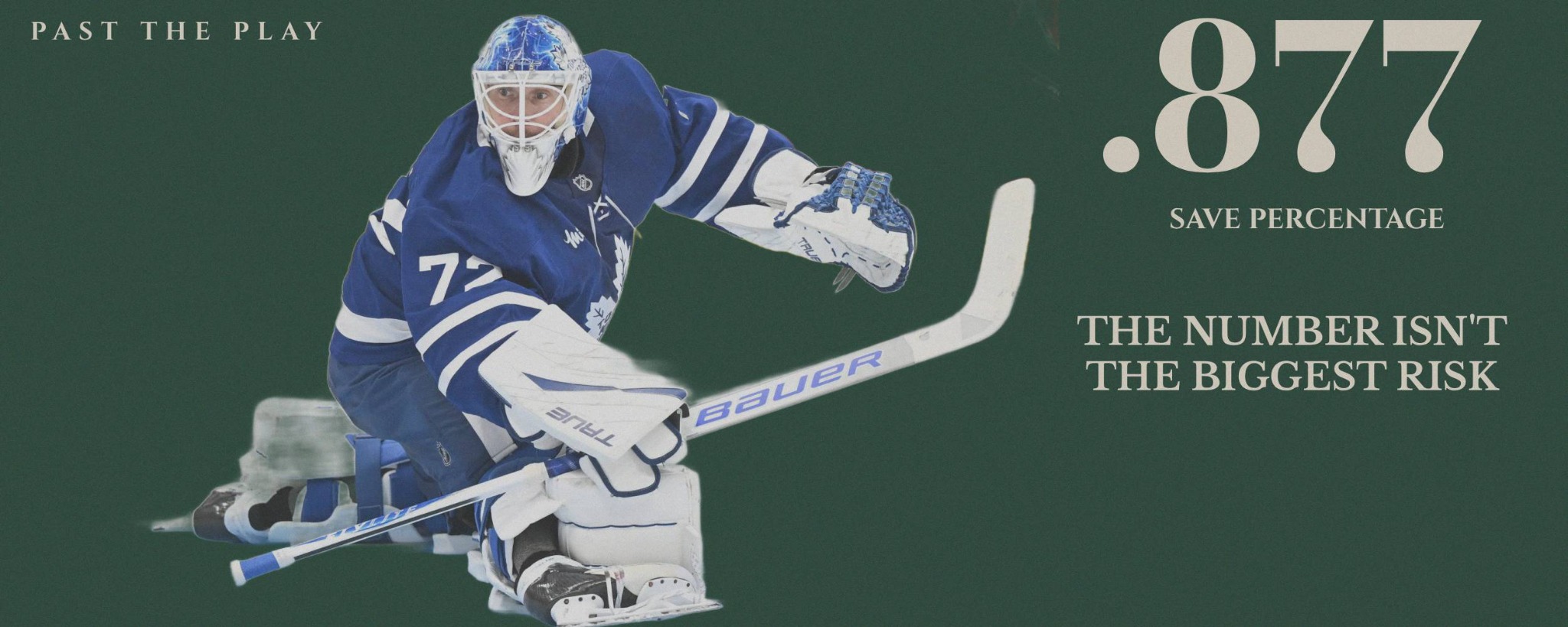
Sergei Bobrovsky turning 38 is going to be the easiest part of his contract to argue about.
Toronto just gave three years and $21 million to a goalie who will be 40 by the end of the deal. The Maple Leafs are coming off a last-place finish in the Atlantic, Auston Matthews has two years left on his contract and this clearly isn't supposed to be a slow rebuild.
So, yes, paying a 38-year-old goalie $7 million per season comes with some pretty obvious risk.
But age isn't actually the part of the Bobrovsky deal that stands out most.
We've seen old goalies play very well before.
Roberto Luongo posted a .929 save percentage at 38. Mike Smith posted a .923. Dominik Hasek was still putting up a .925 at 41. If the only question Toronto had to answer was whether an elite goalie can still be elite in his late 30s, there are enough examples to make the bet perfectly reasonable.
Bobrovsky has also earned the benefit of being compared with those guys. He has two Vezinas, two Stanley Cups and more than 450 wins. This isn't a team talking itself into a 38-year-old because he had a couple of decent seasons.
Where Bobrovsky’s career compared to those goalies becomes different is what happened immediately before Toronto signed him.
Bobrovsky posted an .877 save percentage last season at the age of 37.
And when you go back through the cap era, that's where the comparison starts to disappear.
Nine goalies have started at least 30 games in a season they were 38 years old.
None entered that season after posting below .900 the year before.
Not one.
The lowest were Craig Anderson and Smith at .902.
Bobrovsky is coming from .877.
The .877 is doing a lot of work here
Save percentage obviously isn't a perfect goalie stat.
Florida dealt with major injuries last season, including losing Aleksander Barkov, and goalies don't control what happens in front of them. A clean point shot and a backdoor pass through the slot both count as one shot. Nobody should look at .877 and pretend Bobrovsky played 51 games in a vacuum.
But .877 is low enough that the context has to explain quite a bit.
Bobrovsky faced 1,250 shots last season and stopped 1,096.
The NHL average was .896.
At that rate, a goalie facing the exact same number of shots would have made about 1,120 saves.
That's roughly 24 more.
It would be ridiculous to turn around and say Bobrovsky personally cost Florida 24 goals. That's not how goaltending works and it's definitely not how save percentage works.
It does give you a better idea of the hole we're talking about.
Bobrovsky doesn't need to rediscover a couple of saves over the course of a season to get back to average. He needs a fairly substantial swing.
And the Panthers weren't giving him one of the worst defensive environments in hockey.
Sportsnet found Florida ranked 10th in shot quality against last season. Among the 51 goalies who played at least 30 games, Bobrovsky faced the fourth-fewest shots from the slot per 60 minutes.
He finished last in that group with an .789 save percentage on those slot shots.
That's the number I have a harder time getting past.
Bobrovsky had an .839 save percentage on those same shots over the previous two regular seasons. Florida was limiting how often opponents got into that area better than most teams, and when they did get there, suddenly a much higher percentage was going in.
Maybe that was just one awful year.
Goalies can have those and look like themselves again the next year.
Bobrovsky definitely has enough history behind him to make that explanation believable. His own career hasn't followed a perfectly linear aging curve where he got a little worse every season. He posted an .900 at 30, bounced back to .913 at 31 and was all the way back at .915 at 35.
Then Florida won consecutive Stanley Cups with him in net.
There is absolutely a version of this where we look back next spring and .877 was just the ugly outlier near the end of an otherwise ridiculous career.
Toronto is paying $21 million to find out.
The age comparison gets stranger because of where he's starting
There were only 26 seasons from 2005-06 through last year where a goalie age 38 or older started at least 30 games.
That's probably worth remembering before declaring that goalies can or can't age a certain way. We're already talking about a really weird group of players.
Most goalies never make it anywhere near this point with teams still willing to hand them the net.
The ones who do are survivors.
Hasek. Luongo. Smith. Martin Brodeur. Marc-Andre Fleury. Anderson.
These aren't random goalies who happened to stick around until they were old. For the most part, they're guys who survived because they were really good for a really long time.
Even then, only eight of those 26 seasons finished with a save percentage at or above the league average that year.
That's interesting.
However, I think the previous-season numbers are even more interesting.
Only two of the nine goalies who carried at least 30 starts at exactly 38 actually improved their save percentage from the year before.
Luongo went from .915 to .929.
Smith went from .902 to .923.
Those are two legitimately great late-career seasons, and Smith's is probably the most encouraging historical example Toronto can find.
He improved by 21 points.
Bobrovsky needs to improve by 19 just to get from .877 to last season's league average.
But the only goalie in the group who made a jump that large was already sitting at .902 before he did it.
That's a very different place to try to bounce back from.
Getting Bobrovsky back to .896 would be a major rebound. Getting him back to the .911 he averaged over Florida's two championship seasons would mean improving his save percentage by 34 points.
Toronto doesn't need that second number.
At the same time, it probably can't live with the first one being much lower either.
Toronto has given itself a way for this to work
The Leafs don't necessarily need Bobrovsky to be a 55-start goalie.
Anthony Stolarz is there, and Toronto already knows the two can share a crease because they did it in Florida. A more even split probably makes more sense for Bobrovsky at this point anyway.
Toronto has also spent the offseason changing the team in front of them.
The Leafs had an .889 team save percentage last season. They don't need another Vezina season from Bobrovsky to see a major improvement there. If he gets back around league average, Stolarz gives them competent games behind him and the defensive changes actually work, the position can look dramatically better without Bobrovsky ever resembling his absolute peak.
That's the reasonable case for the signing.
Toronto isn't paying for a normal three-year projection. It's paying for what Bobrovsky might still give them while Matthews' current contract is running.
There is risk on the back end of that deal, but I don't think Year 3 is really the most interesting part.
Only two of the nine age-38 goalies in the sample were still starting 30 games at 40, so there’s a pretty good chance the role looks different by then and the Leafs end up paying heavily on the third year to secure the first two. Maybe Artur Akhtyamov is ready. Maybe Stolarz has established himself as a starter who can carry a much heavier workload. Maybe a higher salary cap makes $7 million easier to carry.
If Toronto gets what it wants in the first two years, I doubt anybody is going to spend much time complaining that the third year of the deal isn’t pretty for its cap after giving them two more chances in the Matthews era.
Looking at the first year is where this gets fascinating.
Bobrovsky doesn't have to prove a goalie can be good at 38 because we’ve already seen it can happen.
He doesn't have to prove an old goalie can suddenly have another great resurgence season either. Smith and Luongo already did that.
He must do it after a season where he posted an .877 save percentage.
The history of aging goalies in the cap era isn’t working heavily in his favour to do so, though.
None of the nine cap-era goalies who started 30 games at 38 came into the season below .900. Bobrovsky isn't barely under that line. He's 23 points below the lowest previous mark of any of the goalies in the group.
Maybe a Hall of Fame-level goalie is exactly the person you bet on to be the first.
Toronto certainly doesn't have three or four years to wait around for a safer answer when they’re tasked with still trying to win now around Auston Matthews, an aging John Tavares and two talents in Nylander and Rielly who have had to listen to hopeful trade talks and rumours for years as Leafs.
For the fanbase and for those four players, the patience has run thin.
But before the Leafs get to find out how well Sergei Bobrovsky ages, they need to find out what happened to Sergei Bobrovsky last season.
Because his age of 38 isn't the number that should scare them most.
.877 is.