
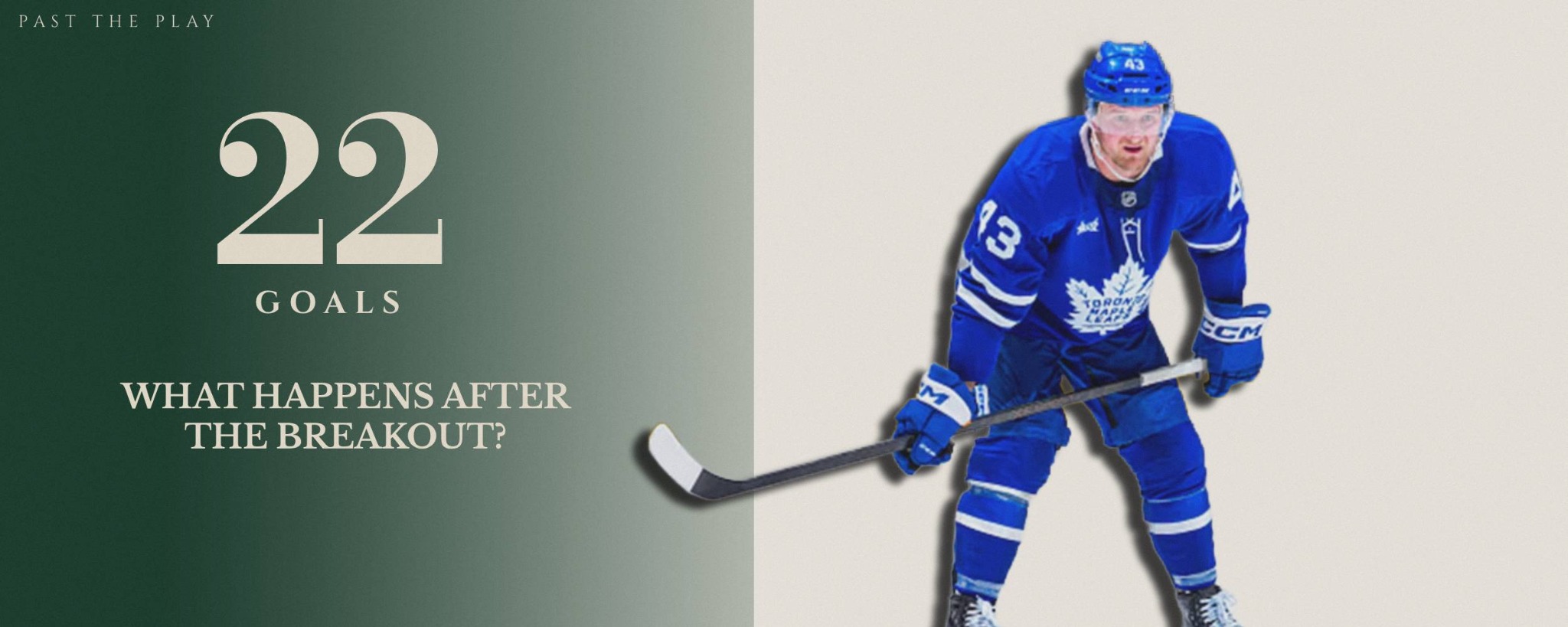
Darren Raddysh scored six goals in 2024-25.
One year later, he scored 22.
He finished with 70 points, led every NHL defenceman with 10 power-play goals and nearly matched the 73 points he had produced across his first 176 NHL games.
Toronto responded by trading a fifth-round pick for his rights and giving him eight years and $68 million.
It is one of the more fascinating bets any team made this summer because the Maple Leafs did not just pay for a good defenceman. They paid immediately after the best season of Raddysh’s career, at age 30, following one of the largest scoring jumps by a defenceman in recent memory.
This is not to say the Leafs necessarily made a mistake, but it does leave one pretty clear question waiting to be asked.
How many of those 22 goals should Toronto actually expect to get again?
I went back through every NHL season from 2005-06 through 2024-25 and tracked every 20-goal season by a defenceman, then followed what happened the next year.
There were 32 qualifying seasons produced by 20 different defencemen.
For the part of the study most relevant to Raddysh, I isolated players reaching 20 goals for the first time in their NHL careers. Mathieu Schneider had already scored 20 before the salary-cap era, while Brent Burns had previously reached 22 while playing forward.
That left 18 true first-career 20-goal seasons.
Only three of those 18 players reached 20 again the following year.
The group averaged 22.1 goals during their breakout seasons.
One year later, they averaged 13.1.
Sixteen of the 18 scored fewer goals.
Twenty goals is usually a peak for NHL defencemen
The interesting thing about the comparison group is how good the players are.
Shea Weber is there. So are Cale Makar, Roman Josi, Victor Hedman, Erik Karlsson, Mark Giordano, Rasmus Dahlin and Dougie Hamilton.
These are not random defencemen who stumbled into a hot season because a few point shots happened to bounce through traffic.
They still usually scored less the next year.
Makar went from 28 goals in 2021-22 to 17. Josi dropped from 23 to 18. Hedman went from 20 to nine. Weber followed his first 23-goal season with 16. MacKenzie Weegar scored 20 for the first time and followed it with eight.
Morgan Rielly went from 20 to three, although he played only 47 games the following season. Sheldon Souray followed 26 goals with three in an injury-shortened 26-game season. Dougie Hamilton scored 22 and then appeared in only 20 games the next year.
There are obvious availability effects in some of these declines, but that doesn't explain the overall pattern.
Only Erik Karlsson, Oliver Ekman-Larsson and Jakob Chychrun followed their first career 20-goal season with another one.
Karlsson went from 20 to 21.
Ekman-Larsson went from 23 to 21.
Chychrun followed 20 goals in 2024-25 with 26 last season.
That means reaching 20 again has happened in only 16.7 percent of the first-time cases in the cap-era sample.
And even that undersells how difficult repeating the exact production can be. Ekman-Larsson technically repeated the threshold while still scoring fewer goals. Karlsson and Chychrun are the only two players in the group who actually increased their goal total the next season.
The point is not that 20 goals makes a defenceman destined to regress. It is that 20 goals is an extreme result for the position.
Defencemen simply do not generate the same volume of high-quality scoring opportunities as forwards. They spend less time around the crease, take more shots through traffic and are often shooting from farther away. A defenceman can have an excellent offensive season without ever approaching 20 goals.
Once a player does get there, repeating it requires a lot to continue going right.
Which brings us back to Raddysh.
Raddysh’s breakout was more than shooting luck
It would be easy to look at the historical numbers and reduce Raddysh’s season to an obvious shooting-percentage regression candidate.
That would miss a pretty important part of what actually happened.
Raddysh scored six goals on 108 shots in 2024-25.
Last season, he scored 22 on 212.
His shooting percentage rose from 5.6 percent to 10.4, but his shot volume nearly doubled at the same time. His power-play goals jumped from two to 10, he played 22:42 per game and received the largest offensive role of his NHL career while Victor Hedman missed significant time.
Raddysh did not produce 70 points by playing exactly the same way he always had and suddenly watching twice as many point shots go in.
His role changed, and alongside it so did his opportunities and involvement.
NHL EDGE tracked him in the 95th percentile among defencemen in offensive-zone time and the 97th percentile in power-play skating distance. He finished third among defencemen in power-play shots and led the NHL in long-range goals.
The Leafs did not make the decision to pay Raddysh $8.5 million per season because they think 22 random point shots found holes.
General manager John Chayka described him as a defenceman who can break pucks out, join the rush, defend the blue line and handle top competition.
Toronto also has an obvious use for his shot.
The Leafs finished 15th on the power play last season and received one power-play goal from a defenceman.
Raddysh scored 10 by himself.
There is a very reasonable hockey argument that the opportunity behind his breakout can survive.
Toronto can put a right-handed shot at the top of a power play containing Auston Matthews, William Nylander, John Tavares and Gavin McKenna. Raddysh should have every reason to keep shooting because Toronto needs exactly what that threat can provide.
Raddysh converted 10.4 percent of his shots last season, almost double his rate over the previous two full seasons.
He also scored nine long-range goals, more than anybody in the NHL.
Having a defenceman capable of beating goalies from distance absolutely changes how a power play can be defended. A penalty kill cannot simply collapse toward Matthews and Tavares if the point shot above them is a legitimate scoring threat.
But long-range goals also come from one of the least dangerous general shooting areas on the ice. There are screens, deflections, traffic, changing sightlines and a degree of randomness involved in whether those shots actually make it through and beat the goalie.
Toronto can reasonably expect Raddysh to remain willing and dangerous from distance.
Expecting nine of those shots to become goals again is a different bet.
Toronto does not need another 22-goal season for this to work
Raddysh is 30, just had a career year and Toronto gave him eight seasons immediately afterward.
Only three of the 18 comparable first-time 20-goal defencemen repeated.
Therefore, bad contract.
That feels far too dismissive of what Raddysh may actually provide the Leafs.
Toronto allowed 3.60 goals per game last season, the second-worst rate in the NHL. Its power play finished 15th. Morgan Rielly produced six power-play points, and the Leafs needed more offence and puck movement from a blue line that struggled to consistently advance play.
Raddysh can score 14 goals next season and still make Toronto considerably better.
That is where the distinction between statistical regression and player regression matters.
Suppose Raddysh finishes next season with 13 or 14 goals instead of 22.
If he is still moving pucks cleanly, running the first power play, producing shots, joining the rush, helping Toronto exit pressure and handling difficult minutes, has he actually become a worse player?
Probably not.
The underlying player Toronto wanted could still be there.
The more important question is whether the structure underneath the 22 goals survives.
Does he keep getting close to 200 shots?
Does Toronto trust him enough defensively to maintain his minutes?
Can he run the power play efficiently?
Does the puck-moving role he established in Tampa Bay transfer to a completely different roster?
Can he continue creating value when the point shot does not go in?
Those are much better tests of the player Toronto committed to for eight years.
The term is where the risk becomes harder to ignore.
Toronto didn’t sign Raddysh for two or three seasons after a breakout. It signed the rest of his thirties at an $8.5-million cap hit.
A rising salary cap should make that number easier to carry, but Toronto needs what happened in Tampa to represent an actual change in Raddysh’s level rather than one perfect season where role, health, opportunity, shot volume and finishing all arrived together.
History gives us a useful distinction here.
Makar went from 28 goals to 17 and remained one of the best defencemen in hockey.
Josi went from 23 to 18.
Hedman went from 20 to nine.
Weber went from 23 to 16.
Weegar went from 20 to eight.
Failing to repeat a career scoring peak did not make any of their breakout 20-goal seasons fraudulent.
It simply meant the peak was a peak.
Darren Raddysh doesn't need to become the fourth player in this 18-player group to repeat 20 goals for Toronto to be happy with the player it acquired.
He just needs enough of everything beneath those goals to remain.
The Leafs have to grade the right version of Raddysh
There are two bad ways Toronto can evaluate this contract next season.
The first is assuming the Leafs bought a 22-goal defenceman and treating anything significantly below that as disappointing.
The second is waiting for his shooting percentage to fall and immediately deciding the entire contract was a mistake.
Toronto should want the process behind Raddysh’s breakout to remain.
More touches leading to more shots and a major power-play role. Clean exits and rush involvement at five-on-five. Enough defensive value that the coaching staff is comfortable using him against good players.
If all of that survives and the goals fall into the low or mid-teens, Toronto may still have signed exactly the defenceman it was hoping to get.
If his shooting percentage falls and the shots disappear, his role shrinks, the puck movement does not carry over and Toronto cannot trust him defensively, then the Leafs have a much larger problem.
At that point, they will not simply have paid for unsustainable finishing.
They may have paid for an opportunity structure that belonged partly to Tampa Bay.
That's the actual bet Toronto made when it gave Raddysh eight years.