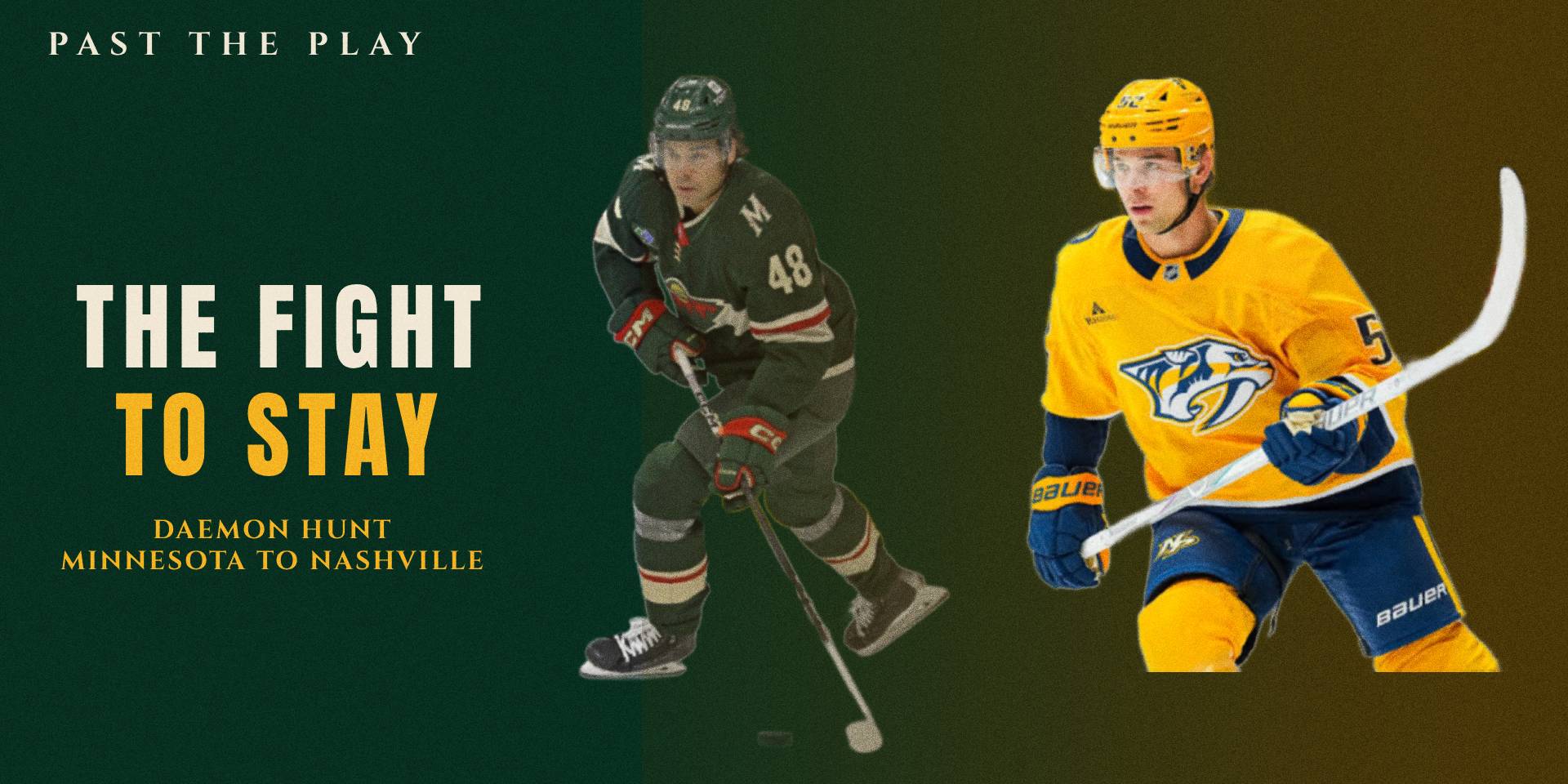
On October 24, Nashville claimed Hunt off waivers from the Minnesota Wild, ending his second stint with the organization that drafted him in 2020. It was his second waiver claim in just over a year, following Minnesota's decision to bring him back from the Columbus Blue Jackets in October 2025.
The destination has changed. The challenge hasn't.
“You’re in the NHL, you’re not playing, but you’re living the dream,” Hunt said earlier this month. “That’s pretty awesome. But as you get older, you wanna stick there, right?”
Hunt has been drafted, developed, traded, waived and claimed by two organizations. Each experience has reinforced the difference between reaching the NHL and becoming someone a team can depend on.
He appeared in 11 games for Minnesota this season, averaging just over 14 minutes per night, before the Wild placed him on waivers. Injured defencemen were returning, and competition for roster spots was intensifying. While Minnesota's precise reasoning for the decision hasn't been established in this reporting, Nashville's claim gave Hunt an opportunity to remain in the NHL rather than report to the American Hockey League.
For Hunt, it was another reminder of how quickly an NHL opportunity can change.
Earlier in his career, he measured progress differently.
“When I was younger, I definitely put up more numbers on the scoresheet,” Hunt said. “But as I’ve gotten older, I’ve realized that, you know, that’s not always gonna happen.”
Hunt once envisioned establishing himself through offensive production. Professional hockey has required him to identify a different path, one built around defending, killing penalties and earning a coaching staff's trust.
“I think knowing your role, that’s really big,” he said. “You’re in the NHL for a reason and you play to your strengths.”
“For me, playing bottom pair, I know what my role is. I’m not gonna be on the power play. I’ve gotta be really good in my D-zone and on the penalty kill.”
It's an understanding shaped by a career that has rarely followed a straightforward path.
Minnesota selected Hunt 65th overall in the 2020 NHL Draft after he emerged as a promising defenceman with the Moose Jaw Warriors. But his junior career was disrupted by a serious forearm injury suffered when a skate blade cut him at 17, requiring surgery. The COVID-19 pandemic brought further interruptions, and the international opportunities he hoped would help establish his reputation never materialized.
“I feel like I missed out on a lot of things that I wanted to showcase, myself and my abilities,” Hunt said.
He wanted to be drafted higher and represent Canada at the World Juniors. Those ambitions mattered to him as a young player, but professional hockey eventually changed his perspective.
“At the end of the day, all the junior hockey and World Junior stuff, that stuff doesn’t really matter,” he said. “Once you hit pro, it’s a whole different level. That’s where guys really show what you’re made of and how well you perform at the highest level in the world.”
The adjustment wasn't just about accepting a different role. It meant learning to play a faster, more demanding game.
Hunt believes his skating and strength have improved considerably since turning professional. But the biggest difference between the AHL and NHL, he says, is how quickly players recognize situations and make decisions.
“You have to know what to do with the puck before you even get it,” he said.
“Every guy thinks the game so well in the NHL. Guys are never out of position.”
Learning to process the game at that speed has been part of Hunt's development. So has learning to handle the uncertainty of whether he'll be in the lineup at all.
In November 2024, Minnesota traded Hunt to Columbus as part of the package for defenceman David Jiricek. After years in the Wild organization, he suddenly had to establish himself somewhere new.
The following training camp, Columbus made him its final cut and placed him on waivers.
Minnesota claimed him.
“I was the last cut and I got put on waivers and brought back to Minnesota,” Hunt said. “I think that was a surreal moment. It was very, like, full circle.”
Rather than dwelling on being traded or waived, Hunt focused on the opportunity to return to an organization he knew.
“I’m very grateful for Bill Guerin bringing me back,” he said. “I think they believed in me and I don’t want to disappoint them.”
Those words carry additional weight after his latest move.
Less than a year after bringing him back, Minnesota exposed Hunt to waivers again. That decision doesn't establish whether the Wild's assessment of his potential had changed, but it meant the organization was prepared to risk losing him.
Nashville took the opportunity.
For the second consecutive season, an NHL club was willing to use a waiver claim to acquire Hunt. That demonstrates interest in what he might contribute, though it offers no guarantee of a permanent roster spot.
The Predators have been making changes to their defence, and Hunt arrives with another opportunity to establish himself at the NHL level.
His previous return to Minnesota produced 34 NHL appearances last season, his highest total in a single campaign. He entered this year feeling better prepared for the demands of the league.
“I’m starting to solidify myself as an NHL defenseman,” Hunt said. “But there’s still a lot of work to be done.”
At the time of our interview, Hunt was receiving additional playing time with Brock Faber unavailable. He described Faber's injury as frightening, particularly because he considers him a friend, but recognized that the resulting opportunity could be important for his own career.
“It’s a very crucial part of my career,” he said. “To be able to step into the lineup… with Brock out, I think it’s very important for me to come in and be consistent and show the coaching staff that I am reliable and they can put me out whenever they want.”
He was talking about Minnesota then. The same challenge now awaits him in Nashville.
Last season also taught Hunt how to prepare for opportunities that might arrive without warning.
“I learnt a lot about staying ready and going into the lineup ready to compete,” he said. “Coming to this year, I feel like I’m more prepared for that.”
For a player trying to establish himself, preparation is only part of the equation. Hunt also believes that being someone teammates want around matters.
“Being a teammate goes a long ways,” he said. “Nobody really wants to have a bad teammate on your team.”
“I try to be a humble guy. I show up to the rink every day. I work hard and I have a smile on my face. It’s one of the best jobs in the world to have.”
I've known Hunt since we were young teenagers in Brandon, long before his career brought him to the NHL. Of all the people I've crossed paths with in hockey, few have left the impression on me that Daemon has.
In my experience, there's a genuine kindness to him that is difficult to capture in an interview. The humility he describes isn't something I've observed only since he became a professional athlete. It's a quality I've associated with him for years.
That familiarity gives me a perspective on Hunt beyond his NHL career, but it also means my assessment of his character comes from someone who knows him personally.
Hockey has faced serious questions about its culture and the conduct of some of its players. Those concerns deserve scrutiny and accountability, neither of which is diminished by positive experiences with individual athletes.
But I also believe there's value in telling the stories of people who approach their profession with humility and kindness.
That doesn't entitle Hunt to an NHL roster spot, nor does it establish his ability as a defenceman. His future in the league will depend on his performance and the decisions of the organizations evaluating him.
And that's where his story returns to the question he raised at the beginning.
Hunt knows he's capable of reaching the NHL. He's already done it. What remains uncertain is whether he can establish himself as an everyday player.
Minnesota traded him, brought him back and eventually exposed him to waivers again. Now Nashville has an opportunity to evaluate what he can contribute.
When Hunt spoke earlier this month, he was focused on becoming someone Minnesota could rely on every night. He'll now have to earn that same trust in Nashville.
The destination has changed, but the ambition hasn't.
“You really have to know your role and know what you are as a teammate,” Hunt said. “Once you figure that out, then you can help the team win by playing your role and showing everybody what you’re capable of.”